Thursday, 21 April 2016

Outsourcing to Nature: Recognizing Brilliance in Other Living Beings

Plants are not objects. On an intellectual level, we all know that. We know that plants are living beings and even that they move - albeit very slowly. However, if you ask most children if they think that plants are objects or creatures, they will answer objects.

A plant sees the light.


 It is a fundamental failure on the part of us people to view other living beings (and even sometimes other people) as objects. Perhaps it's the nature of our ego or our will to survive to see ourselves as more worthy than other living beings. We claim for ourselves the height of evolutionary brilliance because of our ability to dominate and control other beings. Yes, our brains have made us great generalists, so that we can even survive in the most inhospitable climates. But by being a generalist, we also aren't the most advanced or naturally skilled at everything.


Monarch butterflies are an excellent example of how - in comparison - we are troglodytes. Even with the most minute of brains, these butterflies can navigate a complex migration path using light as a guide. Perhaps with our increasing reliance on technology, we have lost this ability to navigate with light. Our technology even stands in the way of even seeing the light. Despite the brilliance of creating GPS systems that can lay out a path for us, we ourselves are not capable of finding a migration path on our own. Are we better than butterflies because we can outsource our navigation or are they better than us because they do it innately? These questions seem to become more and more irrelevant in face of our growing body of knowledge that exposes the sophistication of other living beings' abilities. Is it not time to discard the claims of the Enlightenment: reason and ratio have incurred far more destruction than they have brought light.


At the beginning of the 20th century, there was a small but noticeable trend to recognize the brilliance of many highly specialized adaptations by plants and animals. In recent years, this trend has reappeared in the return to designs in nature to solve issues in robotics and networking. But before this could happen, there needed to be a change in the way we viewed other living beings. We had to overcome our need to sit at the top of the pyramid and outsource our designs to creatures whose abilities far outreached our own.


Nature builds like this (Revue des Monats, 1928)
And people build like this.


Tuesday, 19 May 2015

Post-Soviet Family Cohesiveness: Why Only Half of Us Went to Pinery Park

When I first encountered the eastern European mindset around 10 years ago, I was astonished at how cohesive the group of Russian and Ukrainians were. It seemed as though they would do everything together - to put it in military terms - they wouldn't leave anyone behind. For me this was a bit of a shock, I have always had a streak of efficient laziness. In other words, I would want to get a task done as quickly as possible, which usually meant dividing and conquering. My Western version of social cooperation.

That was 10 years ago. Or maybe we just visit our in-laws too often. Or maybe I'm just too grouchy too often to want spend time with (something about staying in a two bedroom apartment for even one night with four other people makes me want to tear my hair out).

What once astonished me now sets me up for disappointment. When we go to visit, it's an effort to convince everyone that spending time all together would be a good idea. We did after all just spend money to drive all the way to London, Ontario (it's a two hour drive) with a three year old to visit. How outrageous is that? To feel as if your visit is welcomed, your effort is recognized, your presence valued?

The obligation to all agree to do something has faded - there are justifiable excuses not to do something all together. One person doesn't want to do this because it's only for kids. Another person wants to hide inside from the evil pollen out there. Another one doesn't want to drive so far. Yet another one doesn't want to spend the day cooped up inside, dealing with a bored, pouty spouse or eating till the grouchiness compounds into downright hostility (that's me).

There was an insurmountable impasse to spending time all together. Nobody wanted to make an effort to compromise - to bend. We, as much as the others, didn't bend to the others. In fact, going to Pinery Park was a defiance of unnecessary compromise - of bending to another's whims. If there were the hope that others might compromise, we might have felt less defiant. We also might not have spent the day at the beach and walking through the forest.

In the end everyone was happy not to have had to compromise - what is that saying - a good compromise leaves everyone a little dissatisfied.


Friday, 1 May 2015

Skepticism, the Sacred and Sexuality: What to do if you're allergic to spiritualism

The short answer is avoid it and try to keep the gagging to a minimum when confronted by it in any of your acquaintances. I usually also avoid commenting on it, unwilling to rain on anybody's parade even when their parade seems to be founded on such substance as rainbows.

The longer answer comes from the conflation of "consciousness" and "sacred" that like a virus replicates itself in people looking to connect to a movement beyond themselves. Recently I came across advertisements for a sexuality and consciousness conference in Montreal in the springtime. They promise a "transformational" experience that will lead to more "fulfilling relationships" and "magic." In principle I agree with an attempt to remove "shame, guilt and fear related to sexuality and authenticity." If it works for you, then great. Participate in workshops called "SSSEX" (Spiritual Sexual Shamanic Experience Level 1). Participate and meet other like minded folks who will entrench you even further in ideas you share.

I have several problems with conflating sexuality, sacredness, and consciousness as this workshop seems to do. The first is cultural appropriation. I read recently a well-written blog post by a former yoga teacher which outlined her reasons for halting her yoga practice and teaching. She became increasingly troubled by the aspects of yoga that resembled colonialism. This is not to say that "learning" from another culture is forbidden (that would be even worse), but using another culture for your own purpose is separate issue. The brief time I spent on the Sexual Renaissance page, I noticed immediately the motifs from cultures that have a spiritual reputation such as early South Americans who have a history of Shamanic ritual. Why do have stamp our products, our so-called spirituality with another culture? Do we take from other cultures to lend ourselves credence?


A second issue I have with such conferences is the spiritual aspect pure and simple. I find it suspect to heal bodily taboos with the sacred. To put it crudely, it is just replacing one pile of crap with another. I have not done the research, nor can I say assuredly that I am an expert, but I assume a large portion of sexual taboos and shame have been codified through the Judeo-Christian tradition in the West. One could argue that spirituality and organized religion are two separate enterprises, but untangling the two is problematic on many levels.

Simply put, many people still look to organized religion for spiritual guidance, and often on matters directly related to sexuality. Even one as purportedly as open as the "Shamanic" experience they offer is laden with beliefs about sexuality, ones that could easily - if not already - harden into dogma. (Come on, a playboy tantric sex teacher?)

 Furthermore, ladling sex and sexuality with creativity and the sacred ignores one of the most fundamental aspects of sexuality as that which we share with animals - with practically any living creature. It links us with the entirety of the planet not through our human consciousness but in the very absence of it. (And what makes orchid blossoms so delightfully obscene - I have been known to stick my pinkie finger into a blossoms centre with some childish sense of fun).

Sexuality is not sacred. Removing the sacred from sexuality is what will cause the "Sexual Renaissance" they are so desiring. How can we do that? By supporting sexual education in our schools. By not being afraid to teach our children about their bodies from a very young age. Knowledge about their bodies will protect them and give them pause when they explode into a hormone soup during their teenage years. Engaging a new generation of critical thinkers will give them the tools to approach the barrage of hypersexual and often artificially enhanced images with a skeptical eye. To not necessarily believe our senses. To not believe in magic, while wondering at it all.

It is true philosophical skepticism which leads to openness - a kind of secular spiritualism - founded in disbelief.


Wednesday, 18 March 2015

The Plant Gave It to Me: Economics and Nature

For many years, it has been easy to value natural resources at zero. Even though we began to see our negative impact on the natural environment in the 1960s, we have failed to take into consideration nature as both a cost and value. Over the past forty years, this has changed a great deal, and gradually, nature is being recognized in economic theory as a significant factor.

What were the reasons for nature to be ignored? One of the easiest to point out is our distinction between culture and nature. Economic activity has been viewed as a cultural activity. While the context and much of the natural resources have been viewed as outside culture and consequently outside economic activity. As early as 1974, these limitations were being recognized and included economic calculations. E.F. Schumacher used this as his basis for his distinction between "economics" and "meta-economics." The latter being the context for which all economic activity takes place.

While in economics, the natural environment was gradually being recognized as both an ignored factor and additionally, a devalued ethical concern, one forward-thinking German writer was already recognizing "nature" as an economic factor at the fin de siècle. Kurd Lasswitz, a writer known for his contribution to early science fiction, realized that the natural world played a fundamental role in economic success. In his novel, Star-Dew: A Plant from Neptune's Moon (1909), the plant gives a "gift" to humans of a chemical compound that can be used to make a flexible, yet durable material - similar to what we call plastic. By framing the plant compound he calls "rorin" as a "gift," he recognizes that the plant's contribution may not be able to be concretely valued, but that it nonetheless has value. The function of "gift" also attributes an agency of sorts to the ones who give the gifts, while not calling it a human agency. The plants become as persons, but not persons.

Lasswitz' concept of plants as economic factors anticipates in many ways Matthew Hall's argument in Plants as Persons. Although he does not claim that plants are intelligent and sentient in the same way that humans are, he does argue for a view of plants that gives them a similar status to humans. If we can do that for corporations, why not for other non-humans. This improved status may be the final impetus to include plants and other non-human and even the non-living resources in our economic equations.


Tuesday, 10 February 2015

NDP: Win A Date with Tom Mulcair!

The NDP`s latest fundraising campaign offers a chance to watch a hockey game with Tom Mulcair, if you donate as little as 5 dollars to the party. While Tommy may be not as much a draw as say Trudeau for a date, it would still be interesting to sit and grill him about his plans for the party for a couple of hours and make him buy you beer and hot dogs for the exhorbitant arena prices. I have two questions about the campaign. First, why am I ignoring the emails? Second, I wonder how he feels about the whole thing.

https://fbexternal-a.akamaihd.net/safe_image.php?d=AQDXtzTdSIDNIdda&w=470&h=246&url=http%3A%2F%2Fwww.ndp.ca%2Fsites%2Fall%2Fprojects%2Fproject--hockey-night-w-tom%2Fblocks%2Fcontent--social%2Fimages%2FHockeyNightLink_E.jpg%3Fdef&cfs=1&upscale=1&sx=0&sy=0&sw=955&sh=500

I signed up to receive emails from the NDP, so that I could receive updates from the party. Instead, they function as a platform for a big, red "donate now" button. I stopped reading them because the information they send is essentially useless for me and they send far too many of them. I suspect for every forty people like me who views these emails as flies buzzing in my inbox, there is one person who will donate on the tenth email in seven days (I may be exaggerating on the amount of emails - this is my feeling of the frequency). If we follow the law of averages, the more people you contact the more likely they will donate. Great! Simple formula.

http://ecac-parentcenter.org/userfiles/Donate-Now-1024x260.jpg

Or slightly incorrect. For people like me, who aren't inclined to donate willy nilly and get annoyed at the clutter in my inbox, the amount of emails may actually be impacting their perception of the party and may have some further negative consequences far beyond the reach of the campaign. I place my vote based on the party platforms. What if I were to get so irritated at the fundraising tactics that this would bias my interpretation of the platform to the extent I would see otherwise positive goals to actually be negative. How do you fundraise without turning people off from the cause?
 

I don't have a ready answer to that but I do know that this may be fine line to cross.

As for my second question, I am sure that Tommy - may I call you that? - enjoys spending time with a complete stranger who won some contest by donating five dollars to the campaign. Maybe he looks forward to getting to know someone new over a bonding experience like hockey. Dear Tommy I hope you have a great blind date and I hope that the campaign was worth the date.

https://fbexternal-a.akamaihd.net/safe_image.php?d=AQBVUdG7mH2l4gfI&w=470&h=246&url=https%3A%2F%2Fscontent-a-mia.xx.fbcdn.net%2Fhphotos-xaf1%2Fv%2Ft1.0-9%2Fs720x720%2F10171815_773896979313176_729090615127735386_n.jpg%3Foh%3D98d6f77137e4936508e02d2cadafd628%26oe%3D54DB5670&cfs=1&upscale=1

On a side note, this campaign has been part of a larger effort to connect with a younger demographic. Their previous effort to engage young voters with the "pick the best sticker" campaign is another example. "I heart NDP?" Really? I suggest that they may have more success if they dressed Tommy in a flannel shirt and got him to wear a toque. They're already halfway there...

http://www.calgaryherald.com/cms/binary/6927372.jpg


Tuesday, 3 February 2015

Ambivalent Motives: A Backlash Against the "Caring" Insurance Company

http://static6.businessinsider.com/image/54cecfd5eab8ead2592ba36d/nationwides-super-bowl-commercial-about-dead-children-is-about-corporate-profits--in-a-way-that-we-can-all-appreciate.jpg

I don't watch the super bowl, but I ended up watching the "dead boy" commercial (and hearing my neighbours cheer every time someone scored a goal). Nationwide insurance wanted attention. That much is clear. Why else pay for a commercial spot during the super bowl. If this was their sole aim, they have succeeded on that point. Out of all the ads aired during the super bowl, theirs has received the most buzz on twitter and elsewhere.

But, and here is the big but: the response has been largely negative. Why? Because their motives appear ambivalent. Are they airing a commercial because they care about preventing drowning? Or, do they have a more nefarious purpose? One more closely aligned with the central purpose of ad space, selling or promoting a product. After the storm around the ad had already started to rage, Nationwide stepped up to the microphone and claimed that they cared. They were simply trying to start a conversation.

Yet judging from the twitter storm, many believe that they were trying to promote their product on the graves of innocent children. A rather unsettling association to say the least, and I would guess, not the conversation they were intending to start.

Part of the problem stems from the ad itself. Not only does it play on a person's heartstrings (most people do not want children to die, especially a sweet, lovely child like the one on screen), but it also uses the device of a surprise reveal that emphasizes the negative emotions. It is only at the end of the commercial that we learn why the child will never learn to ride a bike, to fly, and to get cooties. The child drowned. The surprise reveal is a trick that acts as an intensification device. In the commercial, it emphasizes an extremely negative outcome that partially places the responsibility for that outcome on the viewers. Ouch. The viewer now feels like they've been tricked and they feel guilty for the child's drowning.

Besides for the heavy emotional content in the context of light entertainment, why would the most negative motive be the one many jump to first? If google is any indicator of the widespread perception of insurance companies, it's not surprising that an insurance company is associated with say, "evil" or "scam" or "crooked." Those three extremely negative associations appear in the top five suggestions when you type in: "insurance companies are..."


Counteracting the negative perception of a company is one of the key motives behind initiating a public awareness campaign like this one here. Even though the company claims that they have been working with experts for more than 60 years to make homes safer, this is not the message that comes across. When designing the campaign, I don't think that the negative associations with insurance companies were taken seriously and addressed outright. The ad appeared to be the sheep's wool, hiding the wolf underneath.

A better strategy would have been to acknowledge the wolf. The ad could have begun with....

"Let's start a conversation about safety"
"We know our money can never compensate for a child's death"
"Meet..."

Then the original ad could have continued and perhaps the backlash would have been different.

Or not. Aren't insurance companies evil?


Friday, 9 January 2015

Why is technology blue?


Why is technology blue? A simple search for technology on Google images brings up a predominantly blue group of images. In the world we live in of extreme gender colour-coding, the first thought that comes to mind is that technology has been coded as masculine. But is this an accurate first impression?


http://kevinmccarthy.com/wp-content/uploads/2013/12/bigstock-Business-technologies-today-43292197.jpg

A simple count of the number of male figures versus female figures in the image reveals that the majority associate male figures with technology, although there are a few female figures.


 This immediately leads to a second question. Is this merely a coincidence or do these images and the colour coding of technology as masculine reflect a reality within industries associated with technological innovations?
 apple ipad logo
 Fortune magazine has compared the diversity numbers between the major tech companies and generally found them lacking. Just taking a look at the male-female ratio, the numbers are appalling. Indiegogo headed out the top of the list with 57% male and 43% female, while Apple with its uncharacteristically blue apple came in second with 72% male and 28% female. If the numbers only include technical workers, then the picture is decidedly more abysmal. Indiegogo still heads out the top with 33% female workers, but Apple's ratio of female workers drops to 20%. 


http://upload.wikimedia.org/wikipedia/commons/thumb/8/84/Apple_Computer_Logo_rainbow.svg/2000px-Apple_Computer_Logo_rainbow.svg.png

The question remains: what happened to Apple's previous rainbow coloured logo? Is that not a better ideal to strive for than a blue one?


http://thebitcoinmovement.com/wp-content/uploads/2014/08/technology.jpg


The predominance of blue in images of technology is not the source of the gender disparity in the tech industry but rather a symptom of a larger issue. The industry seems to have been coded masculine just as other fields have been coded feminine such as education and pharmacy.


http://programs.unisa.edu.au/public/pcms/Portals/0/Discipline_Images/Computers_and_IT.jpg

A biological basis for these differences have long been discounted, so the question of cultural conditioning remains. In a world that is more and more dominated by images, we seem to be subtly reinforcing norms within industries through the visual representations we choose. The answer isn't necessarily to code technology as pink - that would be just falling back into a mindset that excludes rather than includes.
http://www.saesgetters.com/sites/default/files/styles/img_page/public/Technologies.jpg?itok=v1TxMXK0


The images we choose to represent a set of discourses as diverse as technology will change as our concept of technology and who is involved in determining it will change. I would hope that images like the one of the tree will be the reflection of our future. Such images speak to a growing awareness of the impact our changing technology has on our environment and on our neighbours.

Wednesday, 8 October 2014

Fans and Affect: Supernatural, Seinfeld and the Mad Scientist

When I was 9 years old, I had just started at a new school, in a new city and with new people. At that age, they still have show and tell in school. I could think of nothing else but to share my collection of the babysitter club books. I remember setting them down on the table at the front of the room and not much else.


I'm at the point of reconsidering one of my reoccurring narratives. I believe that I am not the type of person who can be considered a fan. I'm not fan because I don't throw myself wholeheartedly and unabashedly into anything - I'm not a fanatic. It's not in my character to be non-skeptical about anything. In everything I do, there is a moment of doubt, which I always associated with distance.

I'm beginning to realize that my image of fans have been very much associated with the negative representation of them in the media and also the rather hypocritical stance in academia that dictates fandom as unprofessional.

The negative representation of fans is pervasive and remarkably gendered. It harkens back to an old association of good ole Freud between women and hysteria. The fan is hysterical to the point of losing control of one's body and actions. One of the first representations of fans came alongside the Beatles' wave of popularity. The image of a Beatles' fan is overwhelming female and hysterical. Footage of the Beatles arriving a new place or venue is often accompanied by the image of a mass of female fans, crying and screaming. I was always fascinated by these images but could never identify with them. My public face is far too stoic to engage in mass emotion.

A more recent representation of the fan comes from the TV show, Supernatural. Supernatural has a complex relationship to its incredibly active fan base - a relationship that sometimes ends up appearing in the show, and even formed one of the threads for a season's narrative. I've only watched up to the 7th season, so I can't speak to later appearances of fans. The fans that appear in Supernatural are presented as defective in some manner. They are often losers, who have in some way a social deficit that they replace with Supernatural. Becky is a clear example of the female, hysterical fan, who uses the show as a replacement for her inadequate reality. She eventually tricks the character, Dean, into marrying her. Her neediness and love for the show are depicted as abnormal and even monstrous. While she redeems herself in the end by behaving correctly, it involves denying herself the life that she wants.

This is not to say that there are no examples of male fans. Another episode in Supernatural features two male fans at a fictional Supernatural fan conference. Yet, the two male fans are depicted as less attractive and less competent than the two main characters from the show.


Similarly, in an episode of Seinfeld called "The Facepainter" being too much of a fan is looked upon with derision. Although all characters of the show are often shown as being sports' fans, their involvement consists mainly of wearing merchandise or watching their team play. When Elaine's boyfriend paints his face and expresses excessive emotion at a game, this is considered to be abnormal behaviour and requires a correction on the part of the girlfriend. The joke on her is that he responds incompletely to her correction by channeling this emotion into another form.

Where are all the positive depictions of fans? Is this why I hesitate to identify as a fan, because I don't want to be stereotyped as one of those hysterical, female fans or as abnormal? Or is it just that I don't want to be considered unprofessional.


Most academics could probably be considered closet fans. I can't speak for other areas, but in the humanities, our research focus is shaped in some way by our personal interests. Identity and research are often bedfellows (but not always). Otherwise, I believe, it would be difficult to find the motivation to spend all that time thinking about it. Sometimes, it occurs the other way around. You'll have to spend time with a topic or author and then you become a fan of it.


I wonder sometimes that if the ant-intellectualism in the broader publics is in part fueled by what is considered an abnormal, obsessional quest for knowledge. Is not the mad scientist, the fan gone academic? He (and they are mostly hes) are the monstrous reflection of the academic who is driven by an obsessive quest for knowledge. The one difference between the fan and the mad scientist is that often the mad scientist is denied emotion to the point of being emotionally cold and inhuman. At other times, the emotional register is also extreme, cue the maniacal laughter...


To that little girl, who liked her books enough to share with the world. It's okay to be a fan.  It's also okay to dare for more than just checking off the "like it" box. To really love it, excessively.

Thursday, 11 September 2014

Ford and Schadenfreude: I am not the essence of good.

Sometimes, I would call myself evil. Yes. Evil. Today, the monstrous me reared its head with ram's horns and mehyed. My evil self is also a goat who likes to eat ice cream every day and drink copious amounts of alcoholic cider.

I wasn't sad when they announced today that Rob Ford had a tumour. In fact, there was more than a glimmer of Schadenfreude. My first thought wasn't well wishes. I thought, "maybe, just maybe, this will keep him from campaigning and we won't have another 4 years of Ford." After announcing to my husband that Ford had a tumour, I also told him that I am evil. Unsurprised he answered, "that's not good."

I may have been evil in other situations. Or perhaps a better word for it would be antisocial. I so badly want to be that nice girl, when really I tend to more of an acerbic wit (and people wonder why I am so quiet - I just don't want to alienate everyone by saying what I really think).


There was a particular uncomfortable situation just two weekends ago when we went to pick up Oliver from his grandparents house. I have rather strong beliefs about food and I often disagree strongly about how they feed both Oliver and his cousin. Not to get into details, I bit my tongue until it turned blue and started to affect the colour of my face. I may have appeared hostile (while trying to seem nice), but at least I didn't confirm their suspicions of my evil nature. Or my conflicted nature - words cannot express my gratitude at having a week of being child-free (but that's for another post).


I suspect my mask of niceness is somehow linked with my obsession with what people think of me. It is starting to fade a bit as I get older, but it's still there. I want people to like me - I generally like them. That's why I don't outright tell people that they're bad parents, bad artists, or just generally off their rocker. Unfortunately I have a face like glass and they probably can tell anyways. Ooops.


It's also why I didn't approach Ford when I saw him on the street at the Cabbage town fest last weekend. I was afraid what would come out of my mouth and also afraid he would brush off the criticism with his own blind delusions of grandeur (not to be confused with the French word for large). Besides, he had a little group of admirers circling around his own orbit and reinforcing his deluded sense of self. It's no wonder.


Tuesday, 12 August 2014

Hidden Hate: A Supposed Non-Conformist Confirms Traditional Gender Roles

I'm appalled and I feel betrayed. I continually attempt to think the best of the many Russian men I know and often disappointed by their beliefs regarding gender roles. This weekend I was confronted with a particularly heinous example. 

I married a Russian man with my eyes wide open and have been often impressed with his progressive views on femininity and masculinity. He sees nothing wrong with expressing affection for his son and performs various household chores. In essence, he is logical to the extreme and has a flexible mind, resulting in openness to otherness. Knowing him, I hope that other Russian men are capable of his strength and beauty.

I am often wrong. Sitting around the campfire this weekend, I expressed pride in the role he plays as an excellent and supporting husband and father. A Russian man responded, "so you're under her heel," in Russian so I wouldn't understand. At some other point, he also implied that my husband's loving behaviour toward his son is unmanly. On the drive home, my husband told me all of this as we were discussing the trip.

It's now clear to me why that Russian man repeatedly expresses wonder at the fact that a Canadian woman has married a Russian. Why would we want to be with a man, who thinks that his wife should do all the housework and take care of the kids while being the principle breadwinner. What is his contribution to the relationship and to the home. And more importantly, how can he declare that he's a non-conformist, when he clearly conforms to century old misconceptions on the abilities and roles of women.

You may wonder why I have couched this in terms of Russian versus Canadian. I am not fond of generalizing, but gender and the cultural differences between Canadians and Russians is a topic that often comes up saddled with a rather ugly form of misogyny. Behind that surprise at a Canadian woman married to a Russian man is often the question of why would a Russian man be with a Canadian woman. Within an integrated Canadian society, Russian men have little of the same unjust rights and expectations that they would have in a segregated Russian community. 

Is that why so many Russian men living in Canada choose to be with Russian women? Do other cultures that have similar repressive views of women also mostly choose women who have been cultured to conform to their expectations?

In 2011, I watched the Russian film, Elena, directed by Andrey Zvyagintsev that encapsulates the dominating perception of women in Russia. A business tycoon marries his nurse whose rights as a wife remain essentially the same as a housekeeper. When learning that she won't be provided for after he dies, she takes drastic measures out of desperation. Jim Hoberman opens his review of the film as a "vivid evocation [...] of Moscow’s contemporary society." 


While he focuses on the class divisions, there is also a limited image of gender identity. The two main female roles, the nurse-wife and the tycoon's daughter, represent two main stereotypes of women in Russian society. One sees women as subservient to men and expected to take care of all the household duties. The other sees women as extremely attractive playgirls, whose purpose in life is to spend their husband/father's money. Another smaller voice whose power is equivalent to her class is evoked in the wife of the nurse's son. Her unplanned pregnancy and dependence on her mother-in-law's handouts reflects the lack of power she has over her body and her finances.


The encounter I had this weekend with one man's derogatory view of equality in praxis confirms for me that feminism is far from being a dead issue. I feel I have no choice but to become an ironic man-hater. As Jess Zimmerman, the editor of the magazine Medium explains, "It's inhabiting the most exaggerated, implausible distortion of your position, in order to show that it's ridiculous."  Maybe the only way to fight misogyny is with irony.


Monday, 28 July 2014

Disturbing Categories: Plants in Peru.


Even more than two months after my dissertation defense, there is one question from a reader that still niggles at me and has to do with our fundamental relationship to plants. The question asked me to reimagine the way I speak about plants - to break apart the framework that we use to understand our relationship to plant, and possibly revolutionize culture studies or to be specific film and lit studies. I was looking for that answer when I visited Peru this past June, and am still far away from answering it.
Two words cropped up in the defense. One, "tool," was mistakenly used by me as I searched for a better one. The second, "medium," was mentioned by a professor in German studies to describe one of the ways nature was integrated in poetry by the Romantics. As a "tool," the plants in stories become objects, instrumentalized and existing only for our purpose. I couldn't have stated it in a way I believe in less. As a "medium," the plant becomes a conduit for a message, an expression of another, but still less of an agent. And after writing so long about plants, I want to see and speak about plants as beings rather than tools or media. 

Yet, what is this other way of thinking?

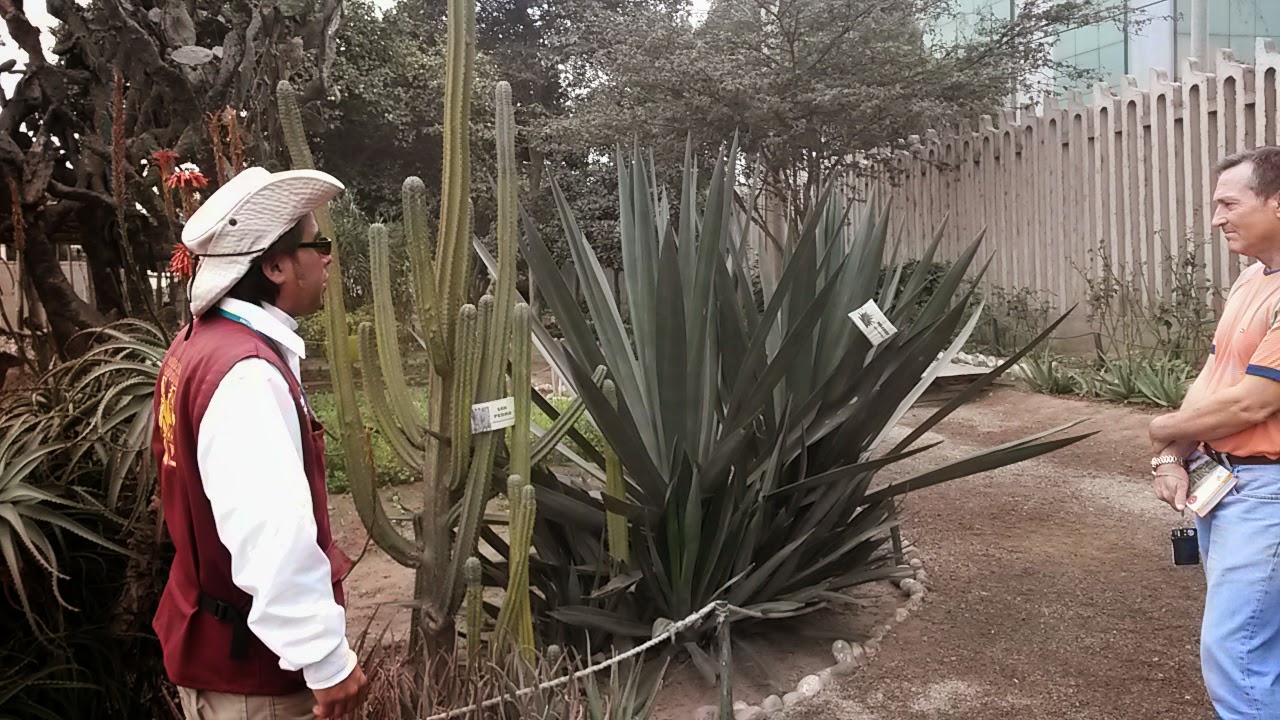
True to my nature, the one museum I was excited about visiting concerned plants. The Plants of Cusco Museum (Museo de Plantas Sagradas, Mágicas, y Medicinales) uses the appeal of hallucinogenic and narcotic plants to draw in visitors.

The room on Ayahuasca brew (Banisteriopsis caapi vine and either leaves from Psychotria genus or Justicia pectoralis) did attempt to replicate the effects of the drug through an overlay of a jungle photograph with an image illustrating the hallucinations. According to the exhibit, the effect of the plant with the guidance of a shaman is to effectively reveal a second nature hidden to our sober senses.

With or without the help of a shaman, this experience is now available to Westerners and it becomes another item to be checked off the psychedelic bucket list.

The room on the role of the coca plant in Peruvian culture was far more educational as it traced a far more integral role of coca leaves than what is portrayed in popular media representations. Used in trading by indigenous peoples, the plant actually contributed to the health and well being of rural farmers by allowing them to obtain food otherwise inaccessible. The coca plant also had a social role as a ritualized greeting. The emphasis on cocaine trafficking rather than the medicinal properties and the cultural meaning of this plant has vastly reduced its significance for those of us who really only come to know the plant through its cultural distillations. Just as the coca plant is reduced to one alkaloid to produce cocaine, our North American understanding is limited to one perspective.

The tour guide at the Lima ruins was quite right to be proud of the plant and its availability in Peru. It's common to find coca tea, coca candy and coca chocolates in gift shops. Yet, this tourist version of the plant has once again limited it to a product.

The museum was about far more than just Ayahuasca and Coca. On one little table tucked away at the back, there were two heavy books on plants and their common usage. Many of the plants listed there were in the process of being studied and some of their traditional uses had been proved or disproved.

These books represented to me a relationship to the environment that can't be measured even as they spoke in quantitative language. The knowledge had been gathered over many generations and over many encounters and cannot be fully distilled into a book. The categorical breakdown of the plants according to measurable criteria was once again just one view of plant but once I reflected on the books, I saw a glimpse into an experiential relationship with plants between the categories.

It is best encapsulated by the differing relationship to plants between my mother-in-law and me. She can walk along the street and see who the plants are through her experience with them that is best described as familiarity. I count the points on the leaves and struggle to later identify them in a book.

To understand a plant, I wonder if the first step is not to experience it as living.


Tuesday, 19 November 2013

Legs and Guns: The Rhythm of the City Million

I've spent a great deal of time searching for images and articles related to my dissertation in magazines from the Weimar era. One of the most accessible sources is the Illustrierte Presse, where many popular magazines have been uploaded. I think I was looking for images of carnivorous plants, when I came across the below collage from Das Kriminal-Magazin.
Das Kriminal-Magazin (April 1929)
The kaleidoscopic arrangement of the images and texts reflects the perception of the city as a rhythmic space of disorder, spectacle and danger. Particularly telling is the association of women in seductive poses with headlines announcing drugs and crime. Women (called the new woman) are as much a threat as other dark corners on the street.

Two headlines stand out as positve amidst the many references to crime. In the top left, the headline, "Ich bin eine anständige Frau ..." (I am a respectable woman) dominates the image. As with the other positive headline in the bottom left hand corner, "Immertreu" (always loyal), the headlines are ironical statements  - they are a knowing wink to the viewer, signaled through quotation marks. The women aren't loyal - they aren't respectable. They are women walking the streets.


Friday, 4 October 2013

The Great Literary Mono-voice: The Author's Lullabye

Am I hearing voices? In short, no. There is just one voice used by every author when reading their work. The soothing voice has great pretensions to literary greatness. It cries out "I am an author" as it lulls me to sleep. I was at the "Word on Street" festival listening to authors present their work and I could barely hear what they were saying. Their voices were the tick, tick, tock of the hypnotist's pendulum rocking me back and forth into a trance of needless phrases. (This is also a problem with academic papers, but we needn't get into that here).

I thought two things.

One. Does anyone write anything remotely original? Are we heading to one great mono-voice that claims to represent a multitude, while in actuality misrepresenting.

Second. Writers don't know how to read. They're boring people who write down all their thoughts because, face-to-face, they can't speak. They're frozen, prudish people who haven't an ounce of drama in their lives because they've spent their lives writing drama.

I definitely know that the second isn't true. Every writer I've met intrigues me. Or maybe they just have a way with words. Gosh, that just hits me close to the heart (or as D. H. Lawrence would say "in the bowels"). You're a writer? Let me buy you that drink.

I suspect that the first is closer to the truth. We may have a fundamental problem that is particularly unique to the digital age. We find what we are looking for and what we are looking for is us. When reading, we gravitate to what we like and what we believe in.

The fact that we are facing an increasingly specialized age and living in spaces with invisible partitions is asking for an incestuous relationship. Meaning, that a community with a variety of people is healthier than one with a homogeneous group. The answer to the "writer's" voice is to start speaking with voices other than those believing to be great big "L". The "writer" has written. It's time to write on. 

Monday, 16 September 2013

On an Ordinary Day: The Tree of Life Loses a Leaf


I should take better care of myself.

This morning as I was walking home from dropping Oliver off at daycare, I saw a middle aged woman struggling to hold up her husband. She was calling out for help, but in a middle of a city so busy as Toronto no one was within earshot. Or maybe no one wanted to hear. The man was in distress, struggling to breath, unresponsive and turning purple.

I ran inside and told the receptionist that a man had collapsed outside. He called 911. Back outside, I lay my purse under the man's head and asked his wife for his name. His hair was shorn and he wore a hearing aid. Three people passed us by, before the doctors ran out and took over.

More and more doctors arrived with a cart of medical equipment that belongs in the OR. I could see the strap of my purse underneath him as they removed his clothes and began CPR. His face had taken on a queer cast. It must have been the shock of seeing someone in such a critical state - I began to cry. The poor woman.

They ushered me inside when the firefighters came. The wife was inside seated alongside two workers who were comforting her. I gave her a hug and sat with her for awhile. After the man had been taken to hospital, a kind hospital administrator asked for my statement. It felt strange that they would be worried for my sake, when I was clearly fine.

I have been feeling unsettled all morning. I tried to write but have been distracted. I'm looking for something. In such a state, it's unpleasant to face the ordinary walls, when I feel anything but usual. I gave the hospital my phone number but I don't expect to hear any further news. I became tangled in a stranger's life at such a significant moment only for my day to continue on as any other day. Her day is anything but. I wish her well.

Today and for the past year, my experiences with the Canadian health care system have tought me that doctors are human beings. The group of doctors who cared for the man were as shaken by the incident as I was. They also spoke of the mistakes that had been made. That's why it is so important to take responsibility for your health and have an advocate. As well-trained, as organized, and as intelligent as they may be, doctors are subject to the same limits as every other person.

As I said, I should take better care of myself.


Friday, 7 June 2013

An Inanity of Mind or the Avocado Contemplations

I have a problem here. And it's not you. At the center of my mind, there's a blank spot. I've stared at the abyss lurking in my innards and watched my clever-most thoughts slide over the edge into the darkness like water over Niagara falls. There should be a Viagra for the mind. I would like to get those sharp little thoughts back up again. You can do it little chicky. Bawk, bawk, bawk. Or should I say...cock-a-doodle-do?

As the work on my dissertation slides into the past - my reflections on vampire plants and other varieties of the dangerous sort - I'm left with the blank spot. It's the part of me lost to the past - to time - to my conscious mind. That part still exists somewhere that is inaccessible to my waking life.

At the end of a long Friday, I sat on my couch with a plate of the food I like best. I noticed that avocado cleanses the palate and the salt in cheese feels like a needle straight to the brain. While eating, I thought of a poem by William Carlos Williams, "The Red Wheelbarrow". His poem, difficult to interpret, seems to claim the sensuous moment over the reflective. His descriptions of the wheelbarrow and the chicken are the sensuous moments. When we really pay attention to what we see, hear, smell, feel and taste, the blank spot becomes a window onto the world. The endless circle of the past, present and future begins then to flow easily.

Time for popcorn.


Friday, 31 May 2013

I'm more beautiful than you think

All that's missing from this Friday is an invitation to a BBQ. Any takers? No? Well, I know I don't have body odor (or do I...?), so that's not the reason I haven't been invited to any BBQs lately. I used to think my social isolation was due to there being something wrong with me. I'm not...just fill in the blank. In general, I don't connect with people well. Phoning people is a herculean effort, much less making small talk. I don't talk small.

Neither do I talk big. Therein lies the problem. I haven't been thinking well enough of myself. According to this lovely article, the majority of people think they're better than average. We think we're more beautiful, smarter and probably more funny. I am funny. Of course, I just don't open my mouth enough for anyone to know.

I've heard this conversation from friends on various topics (and yes, I do have friends even though I don't phone them). Over beer, this unnamed friends, shall we call him Mike, usually lists some study, such as 95% of people are stupid. Mike will then follow up with an example of how other people are stupid and he is not. Good for you Mike. Of course, I always think, how do you know that you're not in the 95%? And how could that even be a reasonable study? Lastly, I've heard you say things that definitely does not place you in that tiny-weeny top 5%. Shall we arm wrestle?

The article concludes that self-aggrandizing behaviour helps boost confidence, which in turn may get us places our current abilities don't warrant, but may eventually merit. Here's to leaping ahead of myself and to thinking I write better than I do. This dissertation is going to be awesome!


Friday, 22 February 2013

Hibernating Mothers and the February Forest: Giving birth Doesn't Mean Giving Up.

I'm utterly exhausted and not a little bit depressed. February is the heavy, gray month that comes after the hangover of Christmas. At least in January, you know that you feel horrible just because you had a fabulous time celebrating with family and friends over the holidays. And now it's morning, so you drink a lot of water and think the feeling will pass.

But in February, you're officially back to normal and the normal is a horrifying abyss with a bottom out of sight. I'm complaining because I'm tired, because I wonder if I've dropped out of the career to have a child, because it's gray outside, and because my little one year old still doesn't sleep through the night without demanding to be nursed. I thought two years old was when they started temper tantrums.

If you could visualize my brain as fuel graph from a Star Trek movie, all the glowing bars would be blinking bright red and there would be a red alert flashing from a huge red light on the wall. And Uhura would be reporting, "All communications are down, sir"

My energy and creative drive is low and I continually wonder if I haven't already given up. Have I given up my dreams in order to be a mommy? Have I leaned back in my chair as Sheryl Sandberg claims many women do as they begin to contemplate a family? Have I stopped raising my hand? Will I ever feel satisfied?

I've never been a loud one and definitely not on the track to CEO-dom, so the kind of success Sandberg is asking women to want doesn't appeal to me. I'm more the kind of person who wishes for a quiet space to create. Maybe the last question in the previous paragraph is the answer to the first. I have no family in the city, a few lovely contacts, a mostly wonderful man as a husband, and I'm tired. Yet, this exhaustion I feel is temporary. The ever present dissatisfaction with my current situation is a sign that I'm asking more for myself than simply watching the years go by. I have not leaned back. I will not always be mired in toddlerhood and that one day I will manage both the writing career I envisage for myself and the beautiful family life. I have just started both.

Friday, 23 November 2012

I Wake to Sleep and Take my Waking Slow

I borrowed this post's title from Theodore Roethke's poem The Waking, a poem that continues to fascinate me even after the 100th time of rocking Oliver to sleep by reciting it. I suppose it is the manner in which the poem emphasizes intuition over reason and paradoxes over purity that has wormed its way into my mind. Lately, the line, "This shaking keeps me steady, I should know" has been returning to me as a mantra for all that I've been through in the past few months.

It's not that I've received particularly tragic news - I don't have cancer with a year left to enjoy my two favourite men, but it has felt catastrophic for my sense of self. And talking about it is part of my new project to allow myself to be vulnerable, a project inspired by a very beautiful and intelligent friend, who I hope blushes if she happens to read this. She sent me a link to a ted talk on connection and vulnerability the day before I went in for surgery. While listening to the insights of the lovely Brené Brown - seeing vulnerability as necessary for joy, I began to cry - I despise the very feeling of being exposed for all to see. I have always loved hiding with my nose in a book away from all disturbances and the grating disappointment I have often felt in my relationships with friends, family and lovers.

Joy has been a difficult thing for me these past few months as I faced a snowballing of increasingly more invasive procedures, ending with four holes punctured in my swollen stomach. The odds of this happening were apparently 1.3 in 1000 - odds that gave me a false sense of security. Of course my superstitious mind remembers the misgivings I had on the day I opted to have the IUD inserted and wishes I had listened. Neither the statistics nor the mythmaking can give me the meaning for which I am searching. Facts can be gathered to reconstruct the course of events, I have a retroverted uterus; the lining of my uterus was thinner due to nursing; so when the doctor inserted the IUD, she punctured a hole in my uterus and the IUD escaped.

This doesn't answer the question why. Nothing can. Joy has been difficult for me to find these past few months.

But not impossible. Just this morning, Oliver, my son, fell asleep before we could even leave the courtyard behind our building. I sat on my scarf on the concrete edging of the lawn and felt the cool breeze on my face. I breathed in the silence of a calm November morning and heard it spread down into my belly. Peaceful.


Sunday, 22 July 2012

21st Century Biological Determinism and a Room of my Own

I took quite a hiatus from blogging as I adjusted to my new role as both a servant and high priestess to a little prince or shall we say my lil' dictator. Instead of the usual personalized Christmas presents this year, we will be sending out a calendar with all of the little facets of my son's dictorial personality. I suppose I should be concerned about losing friends from such a controversial idea ... December will be a reference to Charlie Chaplin's film The Great Dictator.

The first blog back began to grow in importance the longer I let my garden go fallow. I have learned such a great deal about my relationships, myself and the numerous zealots who claim to know how to best be a mom - everything from the breastfeeding fascists, the cloth diaper masochists and the attachment parenting enthusiasts. I didn't know where to start - and I didn't want to start.

I expected more from my husband than I received. Because I believed the crowd of breastfeeding activists and I also wanted to experience this physical closeness to my child, I committed fully to breastfeeding. But, what I didn't anticipate is that breastfeeding would automatically designate me as the primary caregiver in all situations. Especially in the first few months, if my son cried, my husband would shrug off responsibility because he didn't have the lactational superpowers I did. After all of those years of believing my body, my particular mix of biology, is no basis for inequity, it suddenly had become a justifiable reason for my husband to hand me a screaming child as if I had the magical elixir that would transform this red-faced devil into a smiling angel. I often did not have that capacity. My helplessness in the face of his great need and my feeling of abandonment by my best friend saddened me.

I could not do it all. I could not write my dissertation, clean the house, care for a small child and clean those so-called environmentally friendly diapers. We made a spread-sheet to calculate how much it would cost to buy cloth diapers and including the costs of washing them, it turned out to be cheaper than disposables. We forgot to calculate my time. Time I have spent rinsing, washing and assembling them. Time I could have spent writing, interacting with my little boy or caring for myself. Let's also not forget the many night-wakings that could have been prevented if he had been dry. I think sometimes, perhaps I could've been more rested and happier, if I hadn't wanted to be environmentally friendly. At least I can hold onto my self-righteousness, but even that has dissipated. Left is a stinking pile of expensive cloth waste collectors.

Elimination communication has been a far better experience. The week when you catch all poops (and need not clean dirty diapers) becomes a time of sheer exhilaration - you cheer on a red faced little 5 month old as he sits on his potty and think, I have accomplished something. I can read farts.


Not only can I interpret his bowel symphonics, but I can understand his every mood from joy, peace, irritation and sadness as it plays across his features. It's not a rational knowledge, but intuitive as can only come from experience or getting to know someone deeply as you spend time with them. I spend most of my time holding and loving him, but have also discovered how important it is to let go. Without these quiet moments away from everyone I am not as rich a person. It is from my personal development that I will be a better parent and not from spending every waking moment with a little dude attached to me. He has two people to care for him, and to smile with him as he sits in his stroller.

It's my birthday today and the best birthday present I have received was this time to write. May every mother receive a quiet room of her own.

Tuesday, 31 January 2012

A Pregnant Woman's Guide to Hospital Tourism


It wasn't a complete waste of time to visit the maternity ward this afternoon, but it could have been if I were as complacent as most of the other women there. I was surprised at the general lack of questions and at the tour guide's inability to answer most of them (or rather most of mine). I don't blame the tour guide; she's a volunteer and most certainly is only feeding us the information she was given rather than providing a real insider look to the decision making process of the ward.

The tour guide's attitude to the pregnant couples there was also representative of the entire system of maternity information. Like the many books out there, I had the impression she viewed us as pregnant cows without the slightest indication of intelligence and who only needed to be fed sweet tidbits to reassure us.

She joked about how we'll feel when we arrive in labour. It's okay if we feel the need to press the security buzzer a couple of times to be let in. She downplayed the role the woman in the process of giving birth. If you have a plan (she meant birth plan) hand it to your nurse. If you don't have a plan, don't ask me what that is; you'll be delivered no matter what.

The private rooms were similar to this one, but older and smaller.
She wasn't, however, able to inform us about the room rate, the rental costs of a breast pump nor the c-section rate at St. Michael's (which I later found out to be 25-27%, which is on par with the rate in Toronto, ~28%). I didn't ask about the epidural or the pitocin rates, but it wouldn't surprise me if they were also high. Especially considering from the time of admittance, women would only be there maximum 24 to 36 hours in the event of a normal birth.

It is incomprehensible that a woman, who is about to give birth, would not want to know absolutely everything possible about the type of care she could expect. Since becoming pregnant, I have developed the rather engrossing hobby of reading and watching everything I can get my hands on. Without this information, I would be blind and scared, ready to accept everything the almighty doctor told me. This professional might have other concerns than was is ultimately best for my care.

A healthy scepticism of a doctor's recommendation makes a healthy person.

Like most humans, they too make mistakes. Many years ago, I had an earache and went to a clinic. The doctor on call remarked on the health of my tonsils as peered down my throat. When I told him they had been removed, his embarrassment was written all over his blushing cheeks. Because of that rather enlightening experience, I always ask questions.

After the many books I've read and perhaps also because of my previous experiences in the health care system in Canada, I've decided to attempt a home birth. Visiting the hospital today simply confirmed that desire to be in my own space when it comes time to face the pain.